







|
|
 The
Sea Cadets are a uniformed, disciplined youth movement based upon the
customs and traditions of the Royal Navy. Our aim is: To help young
people towards responsible adulthood by encouraging valuable personal
attributes and high standards of conduct using a nautical theme based on
Naval customs. The
Sea Cadets are a uniformed, disciplined youth movement based upon the
customs and traditions of the Royal Navy. Our aim is: To help young
people towards responsible adulthood by encouraging valuable personal
attributes and high standards of conduct using a nautical theme based on
Naval customs.
 |
We can claim the longest continuous history of
any British youth movement, dating back to the Crimean War when
sailors returning home from the campaign formed Naval Lads Brigades to
help orphans in the sea port back streets. |
|
Our origins can be traced back to the Kent port
of Whit stable where the first of the Naval Lads Brigades was
established. |
|
So successful were the Brigades in helping
disadvantaged youth that the Navy League, a national organization a
membership of a quarter of a million dedicated to supporting the Royal
Navy, adopted them in 1910. |
|
Four years later with sponsorship of the
Admiralty, the Sea Cadet Corps was formed. |
|
Sea Cadets served with distinction in both world
wars –in the Second World War, the Corps provided communicators for
the Fleet, with their Units receiving a "bounty" for every trained
signalman who went to sea. They were known as "Bounty Boys". And
tradition lives on. Sea Cadet officers still wear the wavy lace
insignia of the wartime Royal Navy Volunteer Reserve – heroes of the
battle of the Atlantic. |
|
Today the Sea Cadets continue to flourish with
400 units nation-wide and a total of 16,000 Cadets. Unique among cadet
organizations, although sponsored by the Royal Navy, the Corps is also
supported by its own national charity, the Sea Cadet Association which
raises funds for the Corps and maintains the Sea Cadet fleet including
the Corps’ flagship, the square rigged brig Royalist. |
|
Many Sea Cadet Units – known as Training Ships –
are based in inner city areas where they continue to promote the
origins of the movement, providing worthwhile activities for young
people who might otherwise not have the opportunity to develop their
life skills. |
|
Although more than 20 percent of new recruits
embarking on careers in the Royal Navy are Sea Cadets, the movement is
not primarily a pre-service organization, but sets it sights on
equipping young people with the essentials of self reliance, personal
discipline and team work which will hold them in good stead whatever
career they pursue. |
|
Our core training is based on seamanship and
traditional maritime skills, but Cadets can also study mechanical and
electrical engineering, communications, cookery, computers band
musician, Duke of Edinburgh Award Scheme, and a host of associated
subjects to prepare them for adult life. |
|
With the experience of the Sea Cadets under
their belts, many ex-Cadets have risen to the very top of their
professions. Old boys include such famous names as movie star Sean
Connery, Deputy Prime Minister John Prescott, TV personality Rolph
Harris, jazz legend Kenny Ball – not forgetting The Archbishop of
Canterbury. |
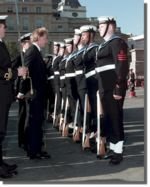 The sea still
plays an important part in our lives. Sea Cadets go to sea aboard Royal
Navy ships, attend courses at Naval bases including helicopter flying at
Naval Air Stations, and fly the flag for the Navy at national events,
highlight of which is the annual Trafalgar Day Parade in London’s
Trafalgar Square to commemorate Admiral Lord Nelson’s death at the
battle of Trafalgar. The sea still
plays an important part in our lives. Sea Cadets go to sea aboard Royal
Navy ships, attend courses at Naval bases including helicopter flying at
Naval Air Stations, and fly the flag for the Navy at national events,
highlight of which is the annual Trafalgar Day Parade in London’s
Trafalgar Square to commemorate Admiral Lord Nelson’s death at the
battle of Trafalgar.
There are opportunities for foreign travel too. The Corps is a
leading light in the International Sea Cadet Association, forging
nautical links with nations around the world from South Africa and
Australia to Bermuda, Canada and the United States of America.
Today, the Sea Cadets have come a long way from those early days in
the seaport back streets when orphans of the war first donned the blue
uniform. Now the Corps continues to offer unrivalled opportunities for
young people aged between 10 and 18 years despite the competing
attractions of the "youth leisure industry".
Why do young people join the Sea Cadets?
Because they want to do something worthwhile - Because they want to
belong to the best youth movement around - Because they want to invest
in their own community and make the most of what the new millennium may
bring - Because they want to meet the challenge of the future with the
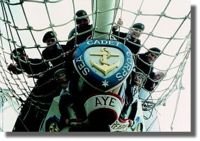
motto – Ready Aye Ready.
|
|


